



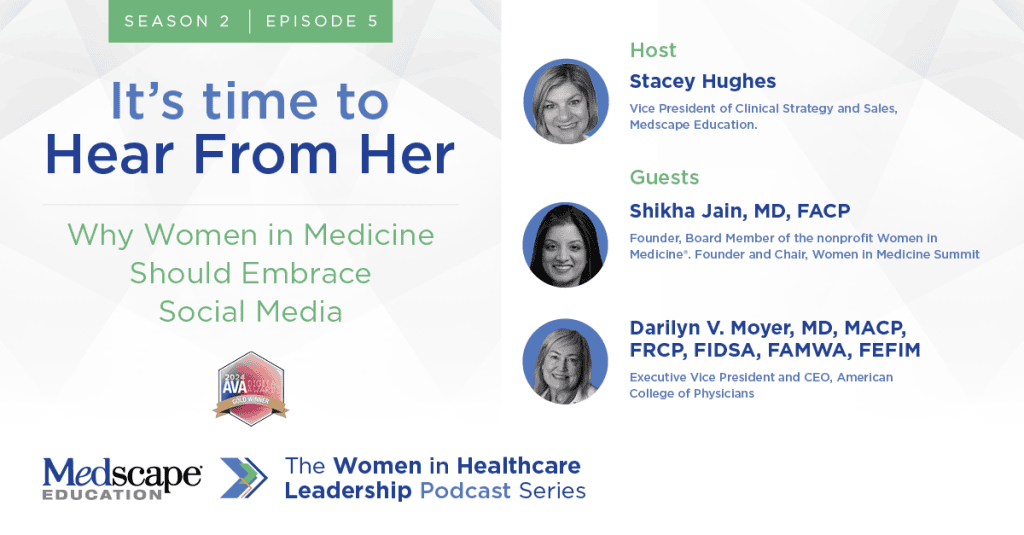
Why Women in Medicine Should Embrace Social Media
May 1, 2024 | Leadership, Women in healthcare, podcast
Of course social media has its downside. But online platforms are a powerful tool for women in medicine in terms of forming communities, fighting misinformation, amplifying one another, and galvanizing support for grassroots organizations to drive change.
Need help navigating social media? Here’s an online toolkit for health professionals.
I never expected to be someone who did anything on social media, says Dr. Shikha Jain, founder and board member of the nonprofit Women in Medicine®. “I used to make fun of Instagram and Twitter. Then I started writing op-eds and publishing, and the hospital I worked at suggested that I use Twitter to engage and get my research out there. That’s how I found myself in the social networking space.”
I was very proud of my first tweet, Jain says. “And then my brother called and said, “You’re too old to be on Twitter because the only one who can see it is me because of the way you formatted it!” Jain shares this mishap as a way of encouraging other clinicians who might feel tentative about dipping their toe into the social media pool.
Since then, both Jain and her mentor (and fellow professional disruptor) Dr. Darilyn Moyer, executive vice president and CEO of the American College of Physicians, say they have experienced the “phenomenal power” of online communities for women in medicine—to fight misinformation, galvanize support for one another, and to promote their own work. “In a healthcare system that is so hierarchical, it’s great to have your own cheerleaders giving you kudos in a public forum like the social networking spaces,” Jain says.
Moyer adds that she’s amazed at how generous people are in terms of offering access to themselves, the time they’ll give you, and the follow-up. In a previous life as an internal medicine residency program director, she saw deans of medical schools respond to students who reached out. “It was a wonderful way to connect and to make incredible professional affiliations to ask for help.”
One of the challenges for women in medicine, says Jain, are the silos that exist within healthcare. Following her annual Women in Medicine Summit, people would ask her, How can we keep the conversations and connections going beyond this once-a-year conference? So Jain, always the innovative thinker, reached out to the women’s professional organization Lean In (leanin.org) about launching “Lean In Circles” — small networking groups of peers who meet regularly to learn and grow together—for healthcare workers. She then called Moyer and proposed a collaboration with ACP, and together they were able to launch Circles for healthcare professionals.
Women in Medicine has launched maybe 30 or 40 Circles, all led by different individuals who want to be leaders, Jain says. Lean In is great in that “they provide not just the structure for these types of Circles but also the content.”
“It’s hard enough being a professional in healthcare, and it’s even harder when you’re a woman,” says Moyer. To be able to support each other within a welcoming, friendly audience, we think is critical to career development. “It also helps with resiliency and to armor you up against burnout.”
What advice would Jain and Moyer offer to someone wanting to test the social media waters?
“Don’t be scared to start,” Jain says. “We are a very supportive community. I never thought that I could reach out to people, especially those who are very famous or very important, but as Darilyn said earlier, you’ll be surprised that most people are willing to respond and help in that space.
“And just remember,” she adds, “we were all where you are.”
You won’t want to miss this conversation. Listen now via Medscape, or on Apple or Spotify, to learn more about Lean In Circles, and the valuable leadership opportunities they provide for women in healthcare.
If you want to join a Circle or get involved, reach out to Women in Medicine and they’ll send you information. Here’s a toolkit to help you navigate the ins and outs of social media.
Hosted by Stacey Hughes, Executive Director, Learning and Development, Medscape Education.
Follow us on LinkedIn for updates on upcoming podcasts and more insightful conversations.
For more information, please contact Jelena Spyropoulos (Global) or Piyali Shin (US).
About Medscape Education Medscape Education (medscape.org) is the leading destination for continuous professional development, consisting of more than 30 specialty-focused destinations offering thousands of free accredited CME and CE courses for physicians, nurses, and other healthcare professionals.
This content was provided by Medscape Education
Company Details

Latest Content from Medscape Education
#ShortenTheJourney
For the millions of people living with a rare disease, the path to a diagnosis (if ever received) is often a long and frustrating odyssey. This delay is frequently driven...
Why We Must Stop Normalizing the “Pregnancy Itch”
In the world of rare diseases, success is often measured by the speed of diagnosis. However, for women facing rare liver conditions like Intrahepatic Cholestasis of Pregnancy (ICP), the medical...
The Greatest Form of Caring: Medscape’s Commitment to Advancing Cardiovascular Health
A February Focus on the Heart While February is known as the month of love, it is also National Heart Month, a time for highlighting the importance of cardiovascular health....
AI, Agility, and Connected Impact at Alliance 2026
Join the Medscape team in Atlanta, February 16–19, 2026, as Alliance celebrates 50 years of excellence in continuing education for health professionals. We’re bringing our 3 decades of experience in...
Why Sleep Health is the Missing Link in Women’s Wellness
While obstructive sleep apnea (OSA) affects approximately 32% of US adults—nearly 80 million people—it remains an "epidemic hiding in plain sight". Perhaps most staggering is that 90% of women with...
The Heart and Mouth Connection Every Woman Needs to Know
For decades, modern medicine has treated the mouth and the body as separate entities. But for Dr. Nieca Goldberg, a renowned cardiologist, and Dr. Maria Ryan, Chief Clinical Officer at...
Uncovering Inequities in Alzheimer’s Disease Screening and Care
On December 5, MAPS hosted an educational webinar exploring recent research in Alzheimer’s disease (AD) screening, testing, and treatment. Experts from Komodo Health and Medscape shared findings from their...
Where Are We Today With Artificial Intelligence (AI) in Rare Disease Diagnosis and Care?
Discover how AI-powered tools are transforming rare disease diagnosis, patient care, and clinical decision-making.
Does Rare Disease Education Work?
For a child with a rare disease, a doctor’s continuing education can end a years-long diagnostic odyssey and unlock access to vital care.
From Genetic Puzzles to Precision Therapeutics
How was a new rare disease discovered through Singapore’s Undiagnosed Disease Program? And how will technology allow us to change how we discover rare diseases in the future? Read more...